
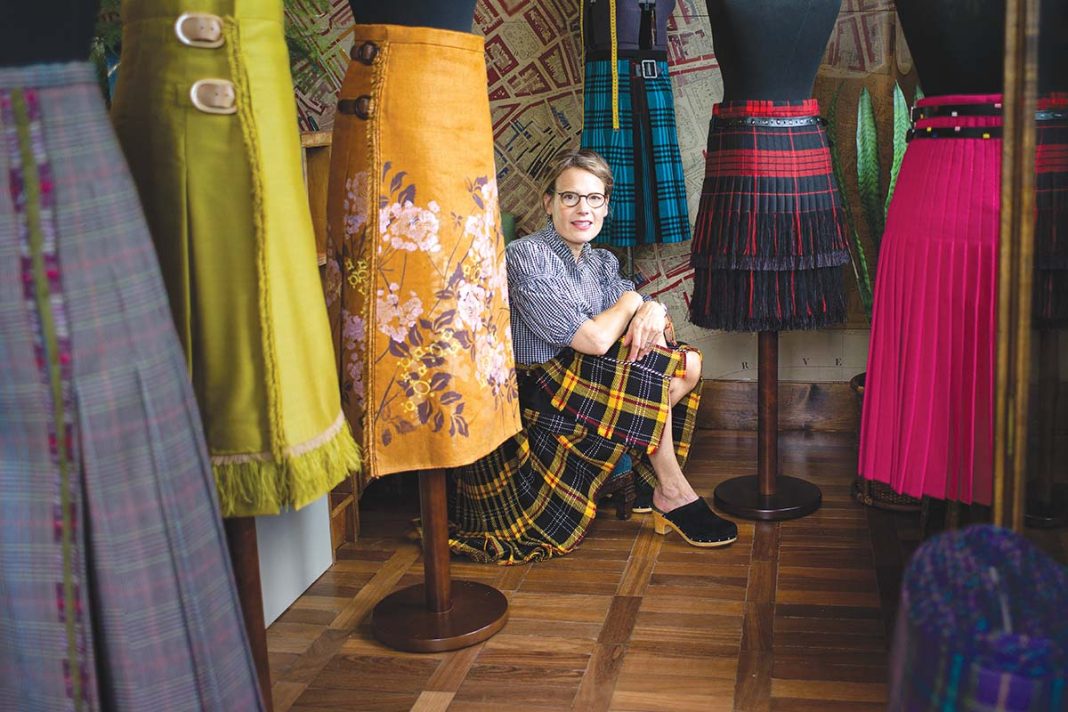
Andrea Chappell tells us about her life in textiles and what drew her to move to Scotland and become a kilt maker
I moved to Scotland 15 years ago with my husband and two young girls. We had spent our holidays here, escaping the daily life of running a design practice in London. We came with the hope of finding a better balance for both family life and our creative practice. I grew up in Bedfordshire – once the production epicentre of bobbin lace, bricks and rush-weaving. The last of these is still thriving, thankfully.
I was taught bobbin lace-making at school lunchtimes and loved it. My great-grandfather was an architect and his son became a construction engineer, and both were considered master craftsmen. I think that the technical side of my work may well have followed their influence, down through my mum, who has inherited their logical and pragmatic approach alongside a dogged work ethic. Her hardworking parents taught her to make everything herself, which included the kilts we wore to school.
These she adapted with Velcro fastenings underneath the straps and buckles to avoid the rigmarole of buckling three young kids up for school. It’s my first and fondest kilt memory. My nan was a fantastic knitter, making the Aran jumpers we also wore to school, for which we entirely lacked any appreciation at the time, desperately wanting the fine-gauge Fred Perry V-necks worn by all the cool kids.
I often wear an Aran with a kilt nowadays, so it has come full circle. I trained in design in the 1990s, back in more analogue days where, between Central Saint Martins and the Royal College of Art, I spent my days in the letterpress studio; it was that initial attraction to print that developed my love affair with traditional crafts.
For thirty years I brought craftspeople into cultural environments through Acme Studios, the multi-disciplinary practice I shared with my husband Gareth. Together we led a small team of designers developing interpretive experiences in museums and visitor centres around the world, working in tandem with curators, contractors and architects to shape stories of people and place. The epilogue to each of those stories was the making of a kilt. It was a commemoration of each project we built that started a (somewhat eccentric) personal tradition and the passion which is now my profession.
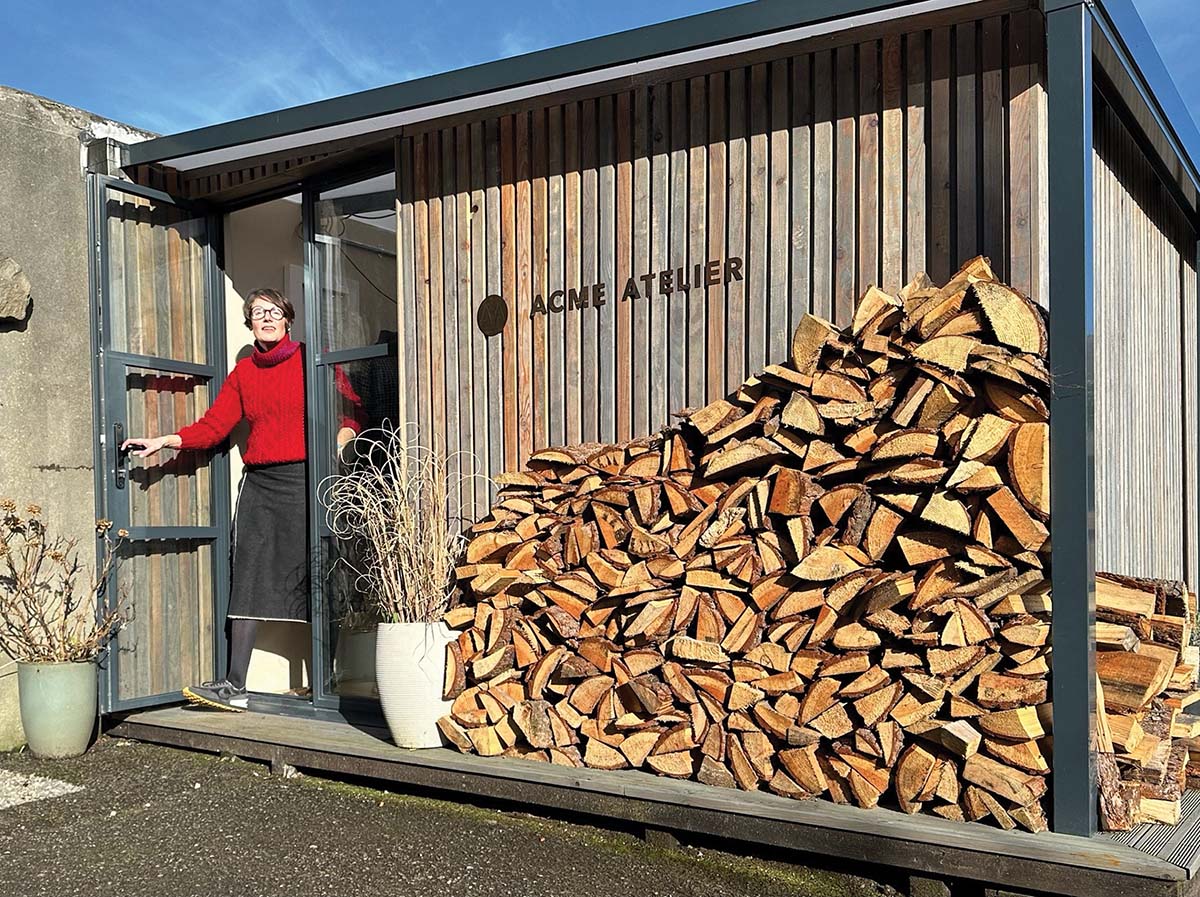
Gareth has developed a breadth of skills in the built environment – furniture-making and restoration – whereas I focus on the textiles. They merge throughout our home and within my workshop, the Pleating Palace, which he rebuilt from an old garage. We have both learned new skills that have forged different creative paths, none of which we could have predicted. Moray has adopted many people like us, creating a diverse range of folk attracted by the light and the life. The community fosters a compelling mix of craft, culture and industry and thrives on collaboration.
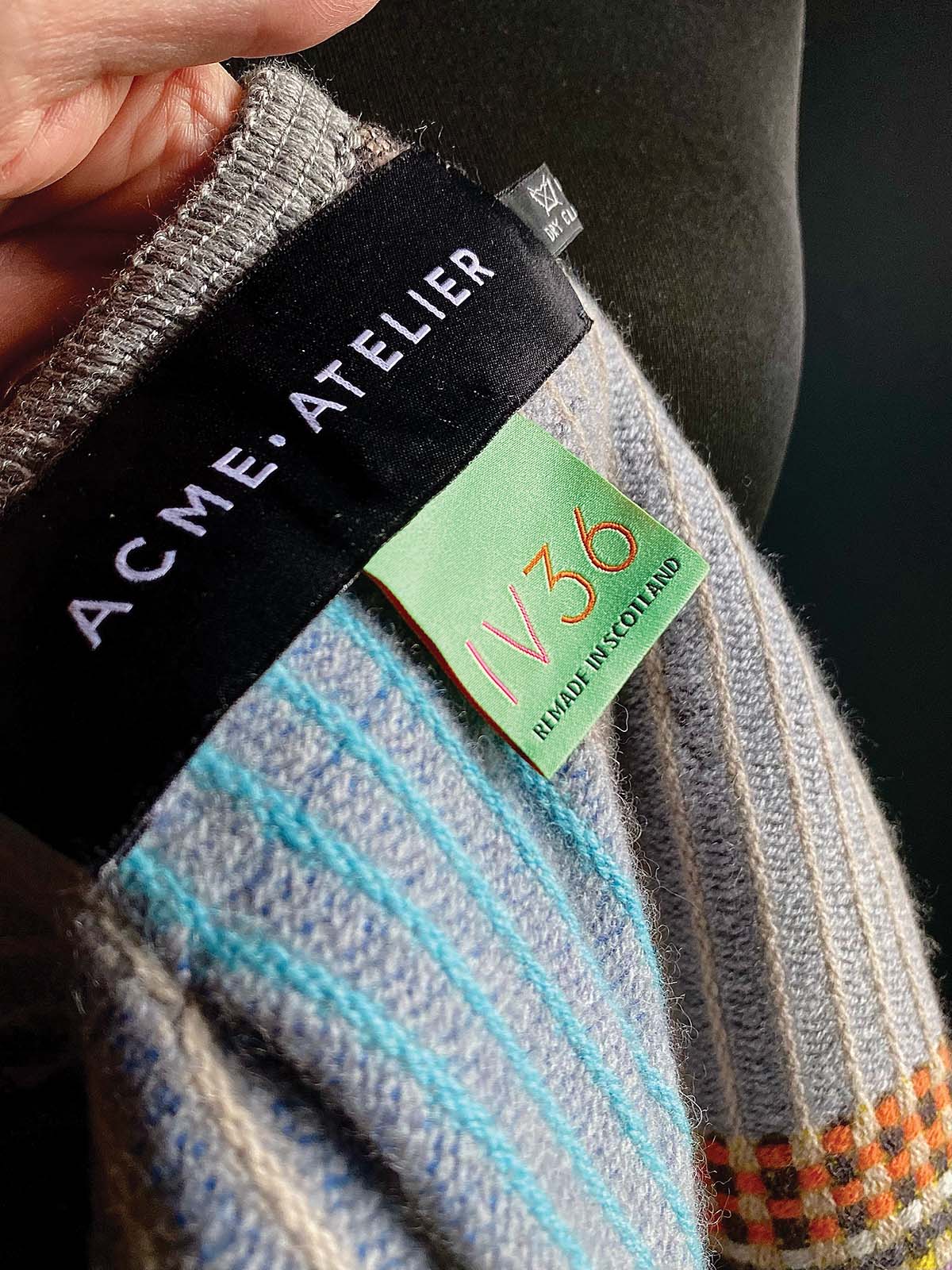
The IV36 Initiative and the Moray Kilt Series, both of which I began in 2021 (when hand-stitched kiltmaking was added to the list of endangered crafts), have been a celebration of that and a way to offer training opportunities back to the community which welcomed us in the first place.
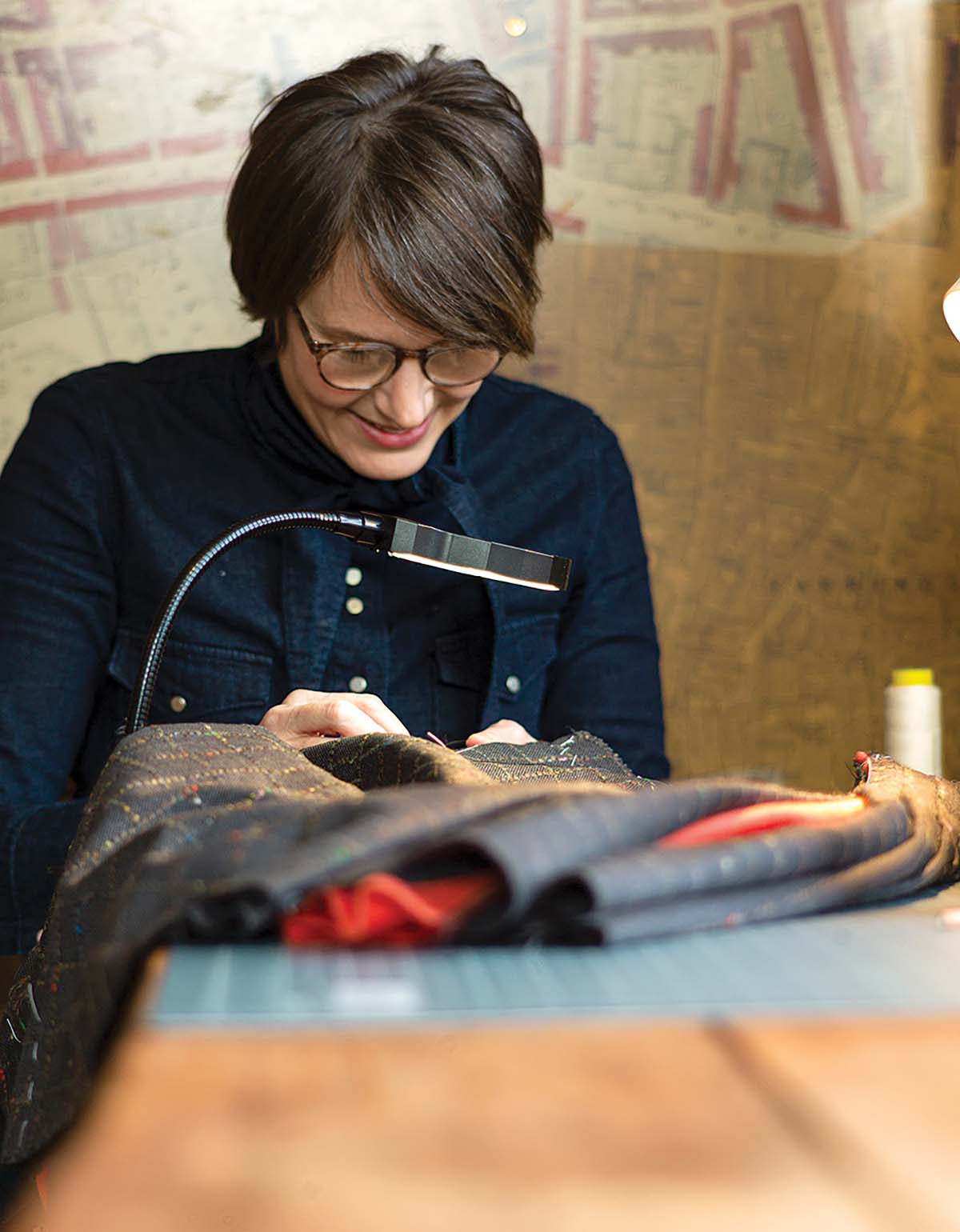
I have multiple kilts on the go at any one time, partly as I find this a more creative way of working, as each one is so different. It’s for practical reason too, as with international clients not all the pieces of the puzzle arrive at once, and some switch and develop as they are being worked on – a vintage buckle, a different leather, a detail that works just fine that didn’t present itself at the outset. I have respect for the traditional hand-stitched process, but not for the slavish repetition of one style of kilt. There is a misunderstanding that kilts are a particular thing, but that was not historically the case, as the National Museum of Scotland’s collection of Highland dress clearly shows. The first kilt was a functional item of workwear, but what’s championed nowadays is a formal version that is based on military dress. That’s a long way from what it was originally, and misses the many iterations, adaptations and evolutions of the kilt that have appeared in the time between.
Scotland is one of the greatest craft nations, as its agricultural, industrial and craft heritage has been integral to its culture, communities and environment for centuries. Its textile infrastructure was once its greatest asset, and not just wool production, but linen, flax and lace too. This is more often celebrated outside Scotland than within it; makers and their products command greater respect overseas than at home. We need greater help to safeguard what is left of the once ubiquitous regional skills and infrastructure that supported both our ecology and communities.
Visit the ACME Atelier website | Follow Andrea Chappell on Instagram